The Model That Didn't Need Eyes
A tiny AI model read my CV in a minute. Then I checked its answers.
Under my desk sits the same modest server as in my last
post: two server processors from 2017, plenty of ordinary memory, and one entry-level graphics card with 4 gigabytes of its own. Last time I tuned that card for speed, and the fastest small model won.
This time I gave it a job where speed is not enough. A job-application assistant I built reads my own CV and turns it into structured data: each job, its title and dates, and what I accomplished there. From that it writes a CV and a cover letter tailored to a job ad. Last time's winner, a model called qwen3.5 with 2 billion parameters, read my CV in 74 seconds.
Then I graded it.
A model that is fast and wrong is not cheap. Someone has to find the errors, and on a CV the errors are the kind a recruiter notices. So I set out to answer three questions: which small model gets the facts right, whether letting it "think" first helps, and what each one costs on this hardware. One model matched my answer key in every run. Another became more than three times faster after I removed a part it never used. The reason it had been slow turned out to be a crash that nobody reported.
The answer key
To grade a model, you need to know the right answers. So I wrote them down by hand, like a teacher preparing an exam: 40 facts across the 5 jobs on my CV, each job's title and dates, 4 education entries, 2 projects, my contact details and 56 skills. Every model got exactly the same CV text, and a script compared what it extracted with the
key.
The key exposed a failure I hadn't thought to look for: misplaced facts. An accomplishment from one job ends up filed under another, an award from one employer credited to a different one. That is worse than a missing fact, because it looks right. A recruiter can't tell, and neither can I at a glance. It is like a clerk who files every page, but some of them in the wrong folders.
The contest
Four small models competed, all stored at 4-bit precision so they fit the card:
- the sprinter, qwen3.5 2B, last time's winner;
- its big sibling, qwen3.5 4B;
- the heavyweight, lfm2.5, which has 8 billion parameters but, as a "mixture of experts", uses only about 1 billion of them for each word piece;
- the newcomer, Google's Gemma 4 E2B, with about 2 billion "effective" parameters.

Figure 1. Reading my CV, with thinking off. Each dot is one run.
| Model | Time to read the CV | Facts found (of 40) | Misplaced | Runs |
|---|---|---|---|---|
| qwen3.5 2B | 73–74 s | 35–38 | 17–18 | 2 |
| lfm2.5 8B-A1B | 1–5.6 min | 38–39 | 1–4 | 3 |
| Gemma 4 E2B | 6.0 min | 35 | 0 | 1 |
| qwen3.5 4B | 8.8–12.5 min | 40 | 0 | 3 |
The sprinter found nearly everything and filed 17 or 18 facts under the wrong job. Gemma misplaced nothing but missed five facts, and it recorded one employer's name as the city the company sits in.
The big sibling was perfect, three runs out of three: every fact, every title, every date. But it doesn't fit on the card. Less than half of it runs on the graphics processor; the rest runs on the old main processors, and it took 9 to 12 minutes to read a two-page CV. The heavyweight, at 1 to 6 minutes with a handful of misplaced facts, was the best compromise.
Should a small model think?
Many newer models can "think": before answering, they write out their reasoning in a separate channel, the way a student works through a problem on scrap paper. For large models this often helps. For small ones, on this card, it mostly didn't.
The sprinter thought in circles. Working on four parts of my CV at once, each request grew to 15,000 to 18,000 tokens of reasoning, with no answer in sight, and I stopped it. The sampling settings its makers recommend for thinking didn't help. It was a student re-reading the question until the exam ended. Its big sibling never finished at all: every stage hit my 30-minute limit (one run). The heavyweight took 25 minutes and turned my 5 jobs into 28 entries, 23 of them titled with the names of the answer
form's own fields, such as "description" and "bullets" (one run).
Gemma was the exception. With thinking on, it found 39 of the 40 facts, misplaced none and kept every job and date straight, in three runs out of three. (One job title stayed slightly off.)
One thinking failure was my own fault. The models fill in an answer form, a JSON schema that lists the fields they must return. In my code, the list of jobs had a default value, so the schema marked it as optional. One model, after thinking at length, simply left the whole section out: zero jobs. Requiring every field fixed it. A model working under a constraint will take every shortcut the form allows.
The eyes it didn't need
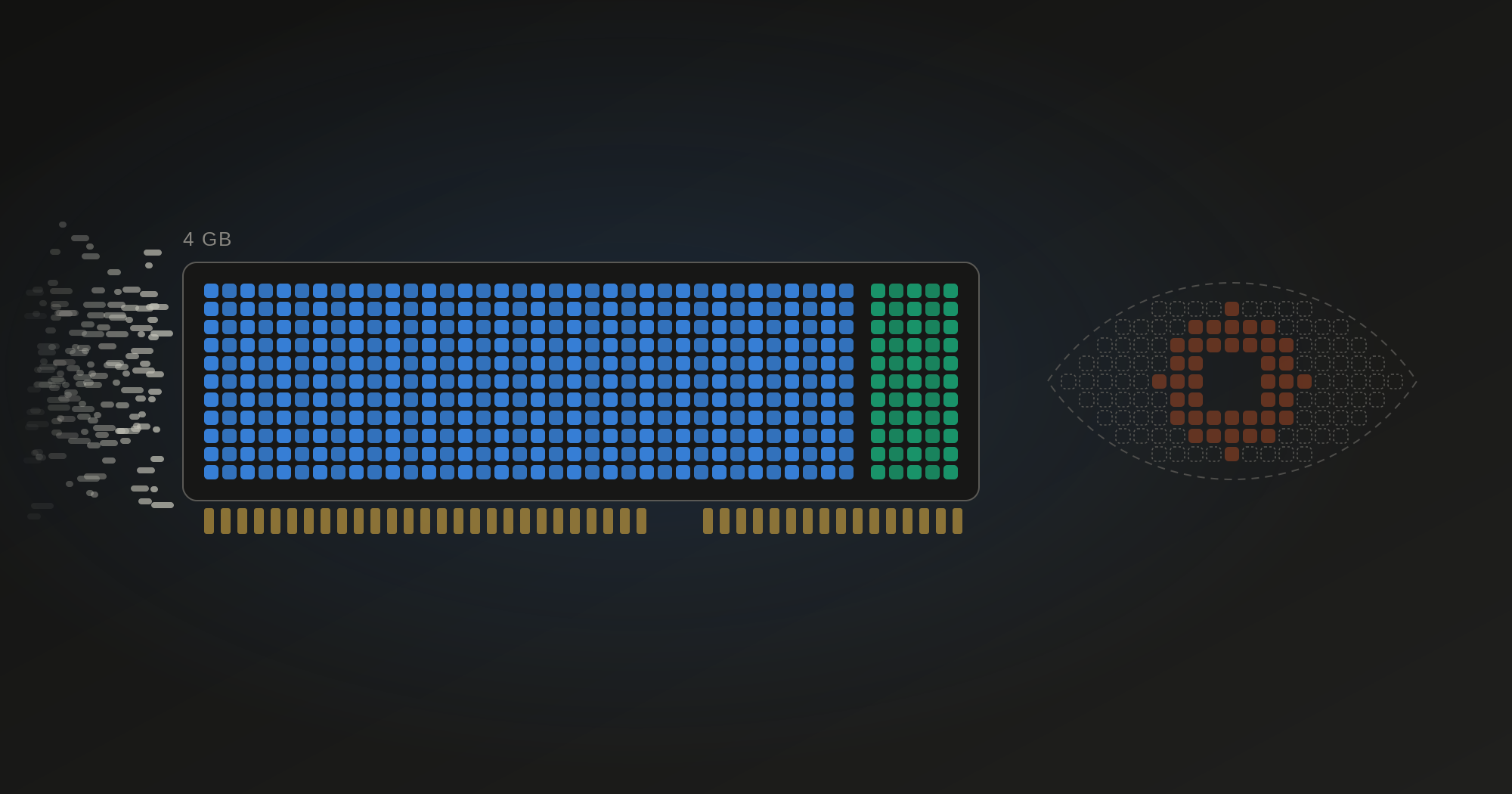
These models can also see. Gemma can hear, too. Images and audio go through a separate component, which turns them into something the language model can read. My workload never sends either. In my last post, the memory set aside for that component cost me half the card, and a single setting won most of it back. This time I went further and
built copies of the models without it.
How to remove a model's eyes. In Ollama, the server software I use, a model is less a single file than a recipe: a short text that points at several files and adds a few instructions. Gemma's recipe points at three files:
- the language model's weights, 3.5 gigabytes;
- a small "draft" model, 98 megabytes, a helper that guesses the next few word pieces so the main model can check them all at once instead of writing them one by one;
- the image-and-audio component, 987 megabytes.
The instructions include a chat template, which lays out a conversation the way the model was trained to read it, a parser for its replies, default sampling settings and the licence. Trimmed, the recipe looks like this:
FROM   sha256-6dd7…    # language weights, 3.5 GB
DRAFT  sha256-dd57…    # draft model, 98 MB
FROM   sha256-7ba3…    # image and audio component, 987 MB  ← delete this line
RENDERER gemma4
PARSER   gemma4
PARAMETER top_k 64
The method has three steps: ask Ollama to print the original model's recipe, delete the line that points at the image component, and build a new model from the edited recipe under a new name. Ollama notices that the weights are already on disk and reuses them, so the copy takes no extra space and is built in seconds.
There are two traps. First, start from the printed recipe, not from the model's name: a recipe that simply says "start from Gemma" inherits all three files, image component included. Second, keep the instructions. The same weights, given a conversation in a format they weren't trained on, may answer worse; I didn't test that, but it is why I kept them. A small script now rebuilds each copy from the original's current recipe, and warns if a copy ever has an image component again. The price is plain: the copy can no longer see or hear, which is fine only if nothing ever asks it to.
For the two qwen models, the result was modest. Each copy needed about 250 megabytes less memory (one load each), and the big sibling, still running mostly off the card, was no faster.
For Gemma, the result was startling.

Figure 2. Gemma 4 E2B with thinking on. The bar is the average of the runs, the line
their range.
| Stage | Original (2 runs) | Text-only copy (3 runs) |
|---|---|---|
| Read the CV | 12.0–12.1 min | 3.4–3.5 min |
| Write the CV | 13.2–14.7 min | 3.3–3.4 min |
| Write the cover letter | 4.8–4.9 min | 2.0 min |
| Facts found / misplaced | 31–34 / 0 | 39 / 0 |
With thinking off, the gap was similar: 6.0 minutes against 2.2 for reading the CV (one run each). The copy was also more accurate in these runs, which I can't explain: the weights are identical, and two or three runs are too few to call that difference real.
The speed difference, though, needed an explanation, and I didn't trust it at first. My first suspect was another model sharing the card. I reran both versions with the card otherwise empty, and the gap held, three runs out of three. Both versions wrote about the same number of tokens, around 5,000 for reading the CV. The original simply wrote them more slowly: roughly 7 tokens per second against 26 (calculated from wall-clock time and token counts, with four requests running at once).
The second suspect was a sceptic's objection: maybe the original was slow only the first time, while it loaded, and a warmed-up original would be just as fast. It wasn't. In the clean run, the original loaded once, in about 18 seconds, and stayed in memory for all three stages, about half an hour in total. Its last stage, the cover letter, started 27 minutes after loading and still took 4.8 minutes against the copy's 2.0.
The explanation was in the server's log. Every time the original loaded, the same three things happened:
- Ollama's memory planner fitted all 36 layers of the language model on the card. Then it loaded the image-and-audio component onto the card as well, ran out of memory, and the server crashed.
- Ollama retried automatically, this time with the component on the main processor.
- But on the retry, the planner kept 2,045 megabytes of the card free: the margin from my last post plus the component's estimated size, as if the component were still going on the card. Only 19 of the 36 layers fit. The other 17 ran on the 2017 processors.
| Load of the original | First attempt | After the retry |
|---|---|---|
| Day 1, evening | 36 layers on the card, then out of memory | 19 of 36 on the card |
| Day 1, night | same | 19 of 36 |
| Day 3, afternoon | same | 19 of 36 |
| Day 3, evening (the clean run) | same | 19 of 36 |
The numbers in the log suggest the planner left the component out of its sums when it did go on the card, and counted it when it didn't. I read the log, not the source code, and this is Ollama 0.40 at the time of writing. It is like a restaurant that seats a guest in the other room, then keeps a table for them anyway.

Figure 3. Where Gemma's 36 layers ran, from the server log.
The text-only copy, with nothing to crash on, put all 36 layers on the card at the first attempt, every time.
The image component doesn't make each word piece more expensive. With all its layers on the card, the original would presumably be as fast as the copy, just as the two qwen versions, which load the same way, ran at the same speed. The problem is that on a 4-gigabyte card the full Gemma can't load cleanly. The copy simply avoids the crash.
Then came the twist. Ollama's own status report said the original was running "100 percent on the GPU", and my benchmark, which trusted that report, said so too. Only the log told the truth.
What still goes wrong
Reading a CV correctly is half the job. Writing is where every model, in every run, still made things up.
In the CVs, models padded my accomplishments with keywords from the job ad. My tool checks that every name, tool and number in a line appears in its source, and it deleted those lines: up to 11 in a single CV. Cover letters aren't checked that way, because a good one has to use the job ad's terms. And every model that wrote one claimed things I haven't done. (The sprinter never managed a cover letter at all: it returned an empty answer, two runs out of two.)
The inventions had two sources. In all 8 of its letters, Gemma named a deep-learning framework that isn't on my CV, and in 7 a statistics metric that appears nowhere in it. Both came from the "evidence" my tool retrieves to back up each claim, which turned out to be stylesheets and unrelated code. The model faithfully used junk. The big sibling used none of the junk, but borrowed the ad's own language, promising "ownership of
training pipelines" for "multi-billion parameter models". It also called me a doctoral candidate. I finished the degree.
A small model is only as honest as what it is fed, and what it is asked to sound like. Fixing the retrieval is the next job.
What 4 gigabytes can do
| Question | Answer on this card |
|---|---|
| Fastest | qwen3.5 2B: about a minute, but 17–18 facts under the wrong job |
| Most accurate | qwen3.5 4B: 40 of 40 in 3 runs, but 9–12 minutes, mostly off the card |
| Best balance | Gemma 4 E2B, text-only, thinking on: 39 of 40, none misplaced, about 9 minutes for all three stages |
| Thinking | hurt the qwen and lfm models here; helped Gemma |
| Text-only copies | about 250 megabytes saved for qwen; 3.5 times faster for Gemma, by avoiding a crash |
The card under my desk still has 4 gigabytes, and the model that does the best work on it can no longer see. The fix wasn't a bigger card. It was reading the log.
How I measured
Hardware: one Nvidia T400 with 4 GB of memory, two Intel Xeon Silver 4110 processors and 141 GB of RAM.
Software: Ollama 0.40.16, which runs models on the llama.cpp engine; model weights at 4-bit precision (Q4_K_M); an 8-bit KV cache; a 32,768-token window; four requests at once.
Inputs: my own CV, one job ad and a fixed set of retrieved evidence, frozen so every run saw the same text. The answer key is mine, written by hand.
Scoring: a fact counts as found if its words appear under the right job, and as misplaced if it belongs to one job and appears under another. Titles and dates are compared after normalizing their format. Cover letters were judged by reading them; the automatic score was too noisy to report.
Repeats: one to three runs per setting, stated with each number. Times are wall-clock per stage; one stage makes several model calls. Memory figures come from one load per model.
GPU share: from Ollama's status report, except where the server log contradicts it (Gemma).
Limits: one CV, one job ad, one machine. Small models vary from run to run: the sprinter misplaced 10 to 18 facts across 3 runs, one of them with its text-only copy. Most thinking results are single runs.